A champion for access and belonging
November 18, 2026 — After graduating from Grinnell in 1968, it took Marilyn Gray Sheperd several years of soul-searching and reflection to understand and appreciate the impact that the College had had on her.
When the opportunity presented itself, she was open to the idea of introducing Grinnell to those students who would highly benefit from what then College had to offer.
After Grinnell, Sheperd earned a Master of Arts in urban studies/affairs from Roosevelt University in Chicago. While in the Windy City, she volunteered for Grinnell at admission events. At one point Sheperd mentioned wanting to help more, and an admissions staff member called about a possible job recruiting minority students to Grinnell.
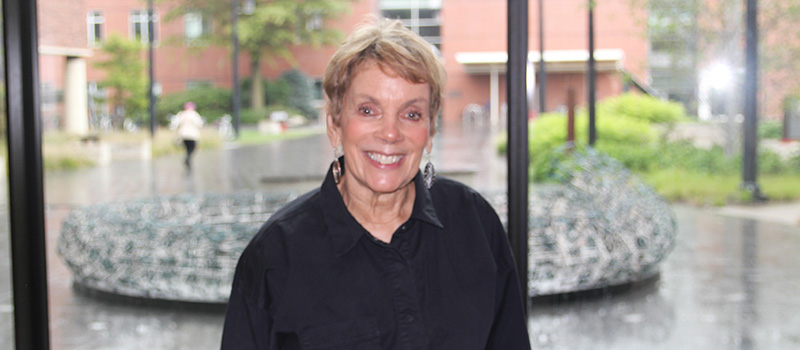 Marilyn Gray Sheperd ’68 visited campus on a rainy Sepetember day. Sheperd worked as Grinnell’s director of minority recruitment in the 1980s.
“We had two different notions of how the job was going to be done,” Sheperd recalls. “The person I was talking with thought I should be on campus working, but I thought it made more sense to work from a place that had a high minority population.”
Ultimately, all parties agreed to have Sheperd based out of Chicago. “I did the job for about eight years. Because I was there in Chicago talking one-on-one with students, I also got to talk with their parents. And then as part of the admissions staff, I would come back and read applications.”
Working as Grinnell’s director of minority recruitment from 1979 well into the 1980s, Sheperd was able to identify countless prospective students of color who were curious about what a strong liberal arts college could offer.
“Seeing is believing was my mantra,” Sheperd noted, so she arranged for as many students as possible to see the campus and talk to current students. There were times when she chartered a bus to bring groups of students to campus; on other occasions she would drive them herself.
“Not everyone who visited ended up enrolling, but usually one or two would.” she says.
While Sheperd’s job was housed in Grinnell’s Admissions Office – which meant recruitment was her primary responsibility – she made sure to keep in touch with the students that she had recruited.
“I ended up driving to Grinnell periodically to see how the students were doing,” she says. “I wanted them to see me as part of their support system. I wanted to be part of their lives. I would listen to how they were doing, whether they were laughing or crying – and there was some of both!”
Sheperd developed a group of about ten Black alumni who met regularly to discuss recruiting efforts and strategies. She also led a conference about minority recruitment in 1981 where 23 Black alums returned to campus.
The efforts paid off. According to enrollment data from the Integrated Post Secondary Education Data System, the percentage of domestic students of color at Grinnell was 5.8 percent in 1980. By 1990, the percentage had increased to 10.1 percent.
As for her own student experiences, Sheperd describes herself as a child of the 1960s. “I was concerned about what was going on in the world, both nationally and internationally. It was often hard to stay focused on academics. There were demonstrations, protests, marches – you name it, we did it! What a time!”
A sociology major at Grinnell, Sheperd and her roommate JoEllen Spriggs-Dixon ’69 played pivotal roles in the formation of the Concerned Black Students (CBS) at the College. “Forming CBS was pure magic,” Sheperd says. “We were energized by the challenges of the time, and we believed that we had the power to change Grinnell and to change the world.”
“No discussion about race and Grinnell during this period would be complete without acknowledging the unconditional support I received from Wally Walker [Grinnell’s dean and executive vice president at the time]. Wally was with me every step of the way. I couldn’t have done this important work without him. President George Drake ’56 also had faith in me and faith in what we were trying to do. Thanks to these two individuals, I was able to take risks, and experiment without having to worry about finding resources to fund our activities.”
After the job at Grinnell, Sheperd enjoyed a long and successful career in institutional advancement, campaign planning and strategic resource development. Her guiding principle has long been that making people feel deeply valued is a key to building philanthropic relationships.
Now retired, Sheperd traveled to Grinnell this September.
“It feels great to be back,” she said at the time, noting that it had been several years since she last returned. “I’m reconnecting with Grinnell, and it feels like I am reconnecting to a part of me that has been tucked away for many years. The buildings look different but there’s something about the culture of this place that gets under your skin. Lucky for us, some things never change.”
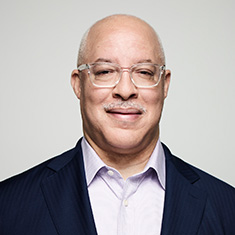 Eric Whitaker ’87
While in Grinnell, Sheperd attended the Laurel Scholars Dinner hosted by President Anne F. Harris. The Laurel Scholarship and Mentorship Program offers robust co-curricular experiences for a cohort of Chicago students. Grinnell awards up to 10 full scholarships annually to high-achieving students who have demonstrated a remarkable commitment to the well-being of their families, communities, or schools.
The informal event gave Sheperd a chance to interact with current students and catch up with fellow attendee Eric Whitaker ’87 who was one of the students from Chicago she recruited to Grinnell in the 1980s. During her remarks, Harris noted the deep generational links present that evening, which started with Sheperd’s recruiting efforts that brought Whitaker to Grinnell. Whitaker’s gift to the College helped launch the scholars program in 2021, bringing about 50 more students from Chicago since then.
Sheperd is pleased by the progress she sees. In the class of 2030, 33 students identify as Black/African American, the highest number for an entering class on record.
“I am blown away by the growth and progress that is occurring,” she says. “Grinnell’s continued commitment to enhancing the diversity of the student population is stunning. I am honored and humbled to be a part of the journey.”
—by Jeremy Shapiro