Grinnell’s Mellon Mays Fellows find early-career success
September 17, 2026 — From the time she was a child growing up outside Chicago, Joy Sales ’13 was fascinated by history. Once she arrived at Grinnell, she fell in love with research.
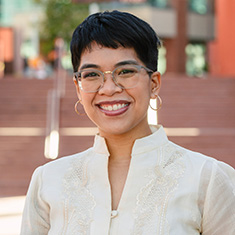 Joy Sales ’13
“I started to see whose voices are represented and prominent in history, and whose are not,” says Sales, now an associate professor of Asian and Asian American Studies at California State University, Los Angeles, who concentrates on Filipino and Asian American history and activism. “When you don’t learn about a certain group or perspective, that needs to be questioned.”
As a Grinnell second-year she read about the Mellon Mays Undergraduate Fellowship Program (MMUF), whose focus is to encourage undergraduates to pursue a Ph.D. and then teach at the university level in order to broaden the range of scholarly perspectives in the academy.
No one in her family had earned a doctorate degree and though she hadn’t previously considered being a professor, the idea of delving deeper into history appealed to Sales. “When the program taught us what being a professor would be and what the academy and grad school was like, I thought, ‘I can do that.’”
This past May, Sales became the first Grinnell Mellon Mays Fellow to earn tenure. And there are likely more on the way. Sales’ classmate, Mateo C. Jarquín ’13, assistant professor of history and director of the Program in War, Diplomacy & Society at Chapman University in California, is up for tenure next spring.
In a program designed to introduce a range of narratives to academia, Grinnell’s Mellon Mays Fellows are making their mark. Grinnell has taken part in the MMUF program since 2008, with an average of 4-5 fellows a year. Any second-year student majoring in the humanities or humanistic social sciences can apply.
The College recently received a $115,000 grant from the Mellon Foundation for the continued support of the fellowship program. The grant will allow Grinnell to continue to provide two, five-student MMUF cohorts per year with stipends, travel and research funding, faculty mentoring, and other support to help students pursue academic careers.
“I really like the program because it has a clear mission,” says faculty coordinator and Associate Professor of Religious Studies and History Elias G. Saba, who himself was a Mellon Mays Fellow as a Cornell University undergraduate. “It helps students think about what life in the academy might look like and is geared toward sending people to Ph.D. programs and on their way to tenure.”
Sales, who earned her master’s and Ph.D. degrees in history from Northwestern University, where she advised Mellon Mays undergraduates, says she’s “been lucky to have Mellon Mays at every step of my journey.” The fellowship also offers funding for an early-career sabbatical, which gave Sales time to write her first book, We Are Revolution: Transnational Filipino American Activism for Liberation.
In addition to grants and fellowships, Mellon Mays provides mentorship and training, along with regional conferences and workshops where undergrads present their research projects to colleagues. That project becomes part of their Ph.D. application, demonstrating research and writing proficiency. And the conferences help develop long-term community among Fellows.
Love of research and teaching
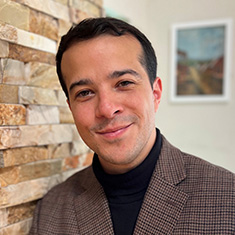 Mateo C. Jarquín ’13
Jarquín earned his Ph.D. at Harvard and began his teaching career in 2019 at Chapman University, focusing on Latin American history. His first book, The Sandinista Revolution: A Global Latin American History, was published in 2024.
“I emphasize the importance of placing the intellectual questions of students and their experiences in a comparative and global context,” he says. “When they take a Latin American history course, it’s to see their own world and lives a little bit differently, and to understand that what happens in this country affects the rest of the world, and vice versa.”
Like Sales, he fell in love with research and history at Grinnell, and it was two faculty members in particular who helped him realize that graduate level work would be both doable and fulfilling.
“A visiting professor of Latin American studies, Carlos de la Torre, pulled me into his office and told me to do a Ph.D.,” Jarquín says. And in his second year, Jarquín’s tutorial professor and advisor, Associate Professor of History J. Pablo Silva, encouraged him to learn about the Mellon Mays fellowship.
Alexandra (Alex) Odom ’16 learned about Mellon Mays in her first year, when Associate Professor of History Albert Lacson called Odom into his office to discuss one of her papers.
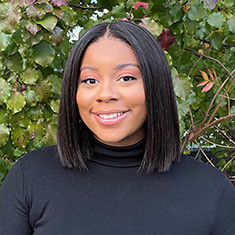 Alexandra (Alex) Odom ’16
“He said I was doing great work and asked if I’d ever considered teaching or earning a Ph.D.,” Odom says. “He told me about Mellon Mays and said it was a great way to get an introduction into the field.”
Odom applied, was accepted and loved the two-year undergraduate project. “I was able to delve into primary sources in a way I hadn’t before – it was my first introduction to that kind of historical research, and the intellectual community formed among Mellon Mays fellows was really great. The highlight was going to annual regional and national conferences and engaging with other fellows.”
Odom, who is the African American Studies and Political Science Librarian at Davis Library, University of North Carolina-Chapel Hill, earned two master’s degrees in history, including one at Queen Mary University of London on a Fulbright scholarship, then her Ph.D. from UNC-Chapel Hill, completed this year.
“There was a point that I was like, ‘I love teaching, but I also really love research,’ and I realized that there was a career where I could meld the two,” she says about her job as an academic librarian. She focuses on helping students, faculty, staff, and visiting scholars navigate all the materials and collections that the library has access to.
“I love working closely with students and helping people navigate historic research. I also love the variety of research and taking on different projects every day, from the Antebellum South, to hip hop, to civil rights, to comic books in the 90s,” she says.
Odom also coordinates a project with undergraduate and graduate students and the local community to compile Wikipedia pages that document Chapel Hill’s historically Black communities.
Sales says the Mellon Mays program helped her learn about the other side of academia and played a role in helping her grow her department of Asian and Asian American studies in the college of ethnic studies.
“I always participate in Mellon activities because it introduces me to people who are doing good work,” she says.
—by Anne Stein ’84