A focus on water and agriculture brings global recognition to Inga Jacobs-Mata ’04
December 18, 2025 — On her first visit back to Iowa in nearly two decades, South African native Inga Jacobs-Mata ’04 had a few important stops to make.
First was to Des Moines to accept a prestigious award from the World Food Prize Foundation, honoring her as one of 39 visionary scientists, farmers, policy advisors, entrepreneurs, and humanitarians named to the 2025 Top Agri-food Pioneers list.
The award recognized Jacobs-Mata, who is director of water, growth and inclusion for the International Water Management Institute, for her leadership in empowering farmers and businesses across East and Southern Africa.
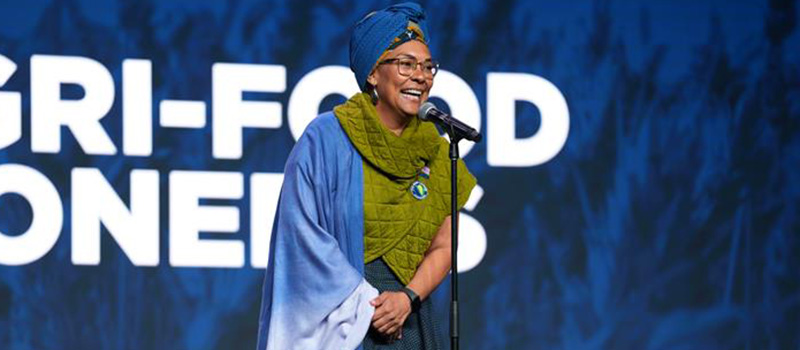 Inga Jacobs-Mata ’04 was chosen as a 2025 Top Agri-food Pioneer by the World Food Prize Foundaiton. She took part in Foundations events in Des Moines.
“It acknowledges leaders in the field who are doing great stuff in areas from policy to advocacy, and for me it’s a team recognition of a special project I had the privilege to lead,” she says. Ukama Ustawi, which translates to “partnership for prosperity,” was implemented in 11 countries in eastern and southern Africa to transform maize-based farming systems that are vulnerable to climate change.
“We reached over 160,000 farmers, more than half women, who are now adopting climate-smart intensification and diversification in maize-based systems,” she says. The project supported women and youth-led startups and enterprises to grow inclusive, climate-smart agribusiness.
Just as important as accepting that prize, however, was a day-long visit to the Grinnell College campus and specifically to see her now 98-year-old ‘host mum,’ Doris Sundell. Many international students at Grinnell are paired with local hosts in the Friends of International Students program.
“I had two very special people, (the late) Don and Doris Sundell, and I was their first host student,” Jacobs-Mata says. “I used to joke with them: ‘You will get many more but remember, I’m the first and favorite.’”
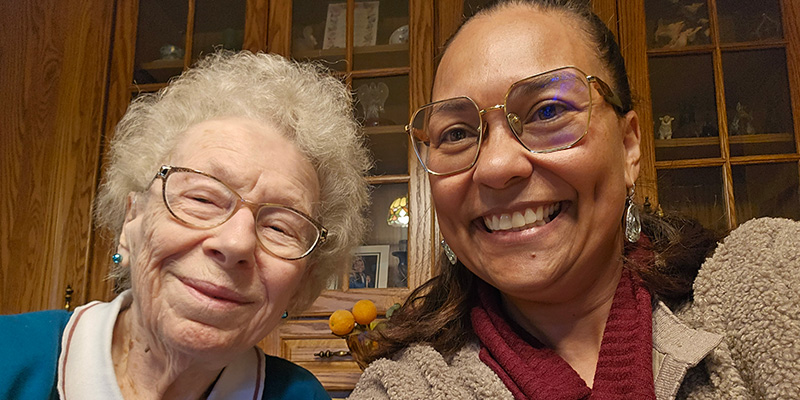 Jacobs-Mata reunited with her Friends of International Students host mother, Doris Sundell, during an October trip to Grinnell.
The Sundells attended her Ph.D. graduation at St. Andrew’s University in Scotland 10 years ago, when Jacobs-Mata earned her doctorate in international relations. They kept in touch with her family over the years and have visited her in South Africa.
Jacobs-Mata, who as a student served as president of the International Student Organization (ISO), also visited with current international students during her time back in Grinnell. And she saw friends and colleagues at Burling Library, where she worked all four years.
Born in Cape Town, South Africa, Jacobs-Mata arrived at Grinnell with two paths in mind: diplomacy or Broadway. “I never thought at that stage that I’d end up in agrifood systems or water governance,” she says. “That came in my post-graduate studies.”
At Grinnell she was involved in the Young, Gifted, and Black (YGB) Gospel Choir, and took every class she could in theatre and dance. At the same time, she majored in international relations with professor Wayne Moyer as her advisor, concentrating on political science, economics, and French.
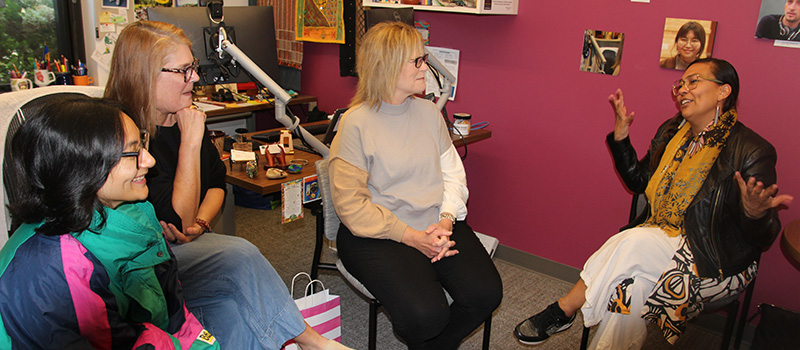 During a visit to campus, Jacob-Mata chats with Diya Shrestha ’26, left, Karen Edwards, and Brenda Strong at the International Student Affairs office.
After graduation she earned a master’s degree in international/global studies from Stellenbosch University in South Africia. “I took a course on conflict in Africa, and there was a module about how the next world war would be around water or another natural resource, and that became the focus of my master’s thesis. It was about how natural resources – rather than a weapon of war – could be a source of peace and cooperation.”
Her Ph.D. thesis focused on water governance, including how water is shared between nations, who benefits when you allocate water, and how to create more equitable sharing arrangements for users and nations. “A large portion of our water in Africa is shared between countries and that requires a lot of diplomacy,” she says.
Jacobs-Mata currently has a global role based in Kenya as the deputy director of the CGIAR Scaling for Impact Program. She and her staff’s work enable hundreds of agribusinesses to secure growth capital, while influencing key water and trade policies that drive food system transformation across the region.
“It’s very meaningful and fulfilling,” she says. “I love that I can work across scales with people from farmers to ministers. I love that I can design programs that have a real impact on the lives of marginalized people in Africa. And I love that I can work in science and innovate.”
—by Anne Stein ’84