Emboldened by her Grinnell values, Ellie Seehorn ’25 earns NSF Graduate Research Fellowship
June 15, 2026 — Double majoring in computer science and sociology at Grinnell, Ellie Seehorn ’25 immersed herself in both academic areas. She conducted research with Rosenfield Professor of Social Studies Karla Erickson and served as a mentor in the computer science department.
“My interest in these majors stems from the understanding that technology doesn’t exist in a vacuum,” she says. “It exists in a human social space, and building something only for the sake of building it doesn’t totally function on an ethical level.”
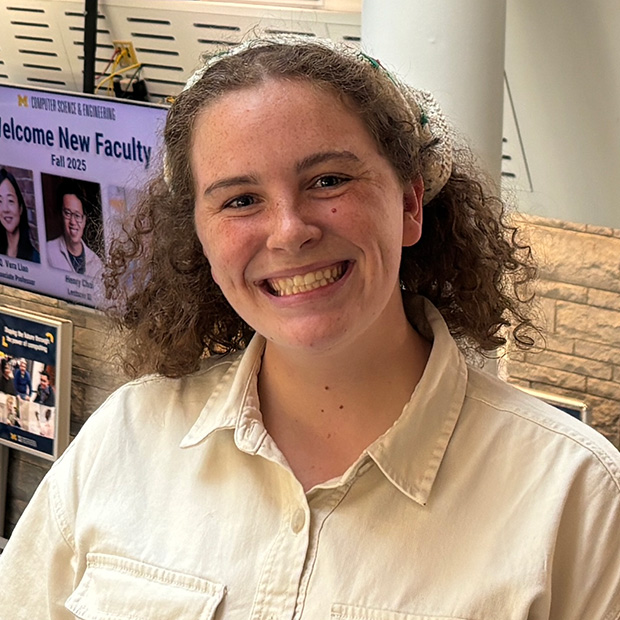 Ellie Seehorn ’25
Now a Ph.D. student in the University of Michigan’s Computer Science and Engineering Division, Seehorn recently received a Graduate Research Fellowships from the National Science Foundation (NSF). Two recent Grinnell graduates, shabab kabir ’26 and Joyce Gill ’26, also were fellowship recipients. One of the nation’s most prestigious fellowships, the award provides graduate students with up to three years of financial support for their research.
“If you are a graduate student in the sciences and meet the eligibility criteria, your advisor will almost certainly encourage you to apply for the fellowship,” Seehorn says. She had to submit her research proposal along with a personal statement. “They want to understand the story of how you were drawn to research, what motivates you, and what your plans are,” she explains.
Generally, her research relates to the intersection of AI – which is increasingly prevalent in the social world – and accessibility, particularly for the blind and low vision community. Recently, this has focused on supporting people in creating custom, do-it-yourself assistive technologies. As part of this, she documents blind users’ experiences throughout the process to truly understand their interests, rather than building a product based on assumptions about what they want or need.
“It allows this to be something empowering rather than another tool shoved in their face,” Seehorn explains. “I want to get away from the mentality of viewing a disability as an inherent problem to be fixed.”
When making her college choice, Grinnell’s open curriculum stood out to Seehorn. “I knew I was looking for a smaller environment for my undergraduate experience,” she says. “I was the first person from my high school to apply in 10 years.”
Admitted at the start of the COVID-19 pandemic, Seehorn opted to take a gap year, staying in her home state of Tennessee to work for U.S. Congressman Jim Cooper. “It was a productive year,” she recalls. “And by the time I arrived at Grinnell, things had become more normalized around COVID.”
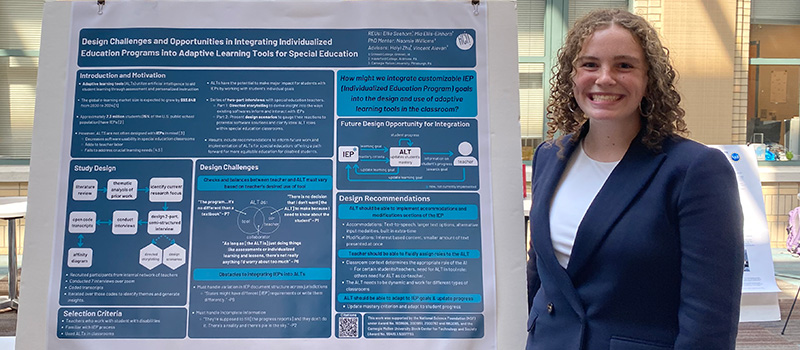 Seehorn presented her research about software-based individual education plans at Carnegie Mellon University the summer between her third and fourth years at Grinnell.
Hoping to do undergraduate research her first summer as a Grinnell student, Seehorn wasn’t sure what she wanted to pursue. Computer science professor Sam Rebelsky, suggested she could do research related to her campus job in the Office of Accessibility and Disability Resources. She applied to dozens of opportunities, ultimately heading to the University of Washington, where she helped develop tactile graphics for the blind and low vision community. The following summer, she did research at Carnegie Mellon University working on software-based individual education plans.
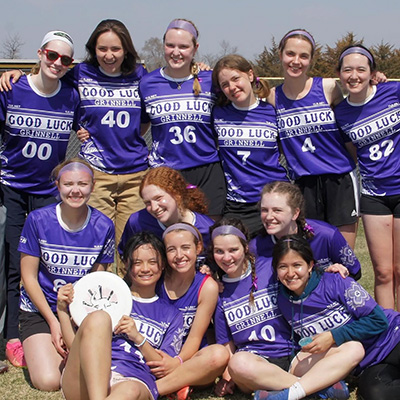 Seehorn and her Grinnell ultimate frisbee teammates
take a group photo.
Seehorn’s final summer as an undergrad landed her at the University of Michigan, working with professor Anhong Guo in the Human-AI Lab whose focus is enhancing accessibility in both the real and digital world. Inspired by what she learned, Seehorn applied and was accepted as a doctoral student continuing under the advisory of Guo as well as Venkatesh Potluri, an associate professor in the School of Information.
Although Michigan is a much bigger school, Seehorn notes how well Grinnell prepared her for this graduate experience. “The type of thinking that Grinnell encouraged in both sociology and computer science classes is productive for a research mindset,” she says. “Rarely are you trying to answer a question that has a known correct answer. Instead, research is the act of making new knowledge and digging past immediate obvious answers. Grinnell set me up to do this.”
With countless hours focused on her academic pursuits, Seehorn looks for ways to release the pressure and stress that can build up. At Grinnell this was through ultimate frisbee. “I loved my teammates and wouldn’t have connected with them in the same way without this opportunity.” She’s looking for similar outlets in grad school and has started playing tennis with other lab mates.
At Grinnell, Seehorn helped launch a middle school chapter of Girls Who Code, which is now being expanded into the high school. Through this program, students are exposed to computer science at a crucial time in their lives when they are cultivating their interests. “It was valuable to me that this became something on their radar even if not every student decided to do computer science,” she says.
As she looks to her future, Seehorn knows that her work will continue to meld the human side of interactive software and other technology.
“My NSF grant came as a happy surprise,” she says. “I am committed to increasing the representation of women and people with disabilities through my research. Grinnell highly values caring about other people and the world around you. I had this interest prior to Grinnell, but I credit Grinnell for emboldening it.”
—by Melanie Drake ’92
For your information:
With its inception in 1952, the NSF Graduate Research Fellowship Program is the country’s longest-running, sustained investment in developing the STEM workforce. Read more about it in this year’s award announcement.
To read more alumni news, check out our news archive and like the Alumni & Friends Facebook page.