One of Grinnell’s first computer science graduates returns for a week of conversations, mentoring
May 21, 2026 — While the computer science field has evolved in countless ways since Ali Akgün graduated from Grinnell College in 1993, the questions he received from students during his visit to Grinnell last month seemed relatively familiar.
“They wanted to know what will the world be like? What will the computer science work environment be like? What will the industry be like? Should I be following my passion, or should I be following what makes money? We all have these questions when we first start out on our careers. I had them 30 years ago.”
Akgün, whose career took him to Seattle and eventually a role in Microsoft’s AI leadership team, spent April 14-17 in Grinnell as an expert-in-residence for the Computer Science Department. His wife, Jennifer Wang ’92, and their youngest son, Kaan, also made the trip.
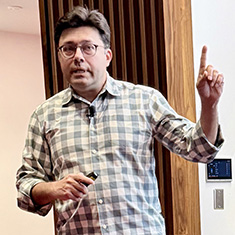 Ali Akgün ’93
“We hadn’t been back in such a long time, so it was really great to see what things are different,” Akgün says. “Everything looks new, but it’s also the old Grinnell mixed in there. Overall, I enjoyed having conversations with the CS [Computer Science] faculty and both CS and non-CS students to get a feel for what they’re thinking about what’s happening in the world right now, especially around AI and computer science. Having those conversations and hearing different perspectives from people that aren’t in the industry was really great.”
Originally from Turkey, Akgün was one of four students that were the first to graduate from Grinnell as computer science majors. In his 30-plus year career, he helped found Microsoft Surface, led major product efforts across the company, and most recently served as corporate vice president for mobile experiences and platforms, where he helped implement the first mobile versions of Microsoft Copilot.
On April 16, Akgün gave a campus talk titled “How AI Works, And How It’s Changing the Way We Work.” He first provided the nuts-and-bolts basics about AI and then spent 20 minutes discussing how it affects how people do their work.
“There were some interesting questions and rightfully quite a bit of concerns about things surrounding AI,” he says. “Because Grinnell is not simply focused on professional degrees or business training, like let’s go squeeze profits out of this, the audience response had to do with let’s understand it, let’s work with it, but also let’s think deeply about what this means for society, for culture, for human relations, etc.”
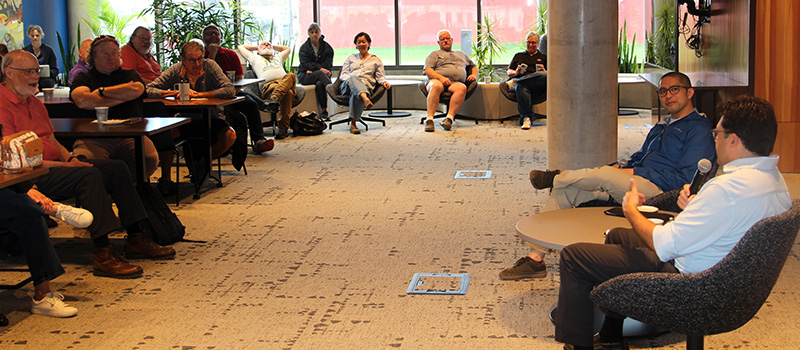 Students and community members asked several questions about AI during Coffee with the College in the Katherine Howell Weingart '61 Civic Innovation Pavilion.
Akgün said Grinnell is teaching computer science at a moment when there are questions about whether AI is starting to make some aspects of computer science obsolete.
“The faculty is thinking about this as they are teaching the kids fundamentals of computer science, not programming. And I really love that,” he says. “You can sit with an AI based coding tool and make it write code. But if you understand computer science fundamentals, you will ask it, tell it, direct it to build better than if you didn’t. So there is still this huge space for computer science folks. The tools are changing. But I think the need for computer science people and the need for understanding of fundamentals of computer science is there still, just lying under a different set of tools that we’re using today.”
Associate Professor Peter-Michael Osera, who serves as the computer science department chair, said while faculty members have been studying and discussing AI for a number of years, hearing from Akgün was critical.
“Even with our efforts, which are fairly significant, we still don’t have a great sense of what the current industrial trends look like,” Osera says. “The College is hesitant to introduce AI in the classroom because it’s disrupting pedagogical goals. Nonetheless, it’s important to hear where it is being used and where an industry veteran thinks it’s going, so we can figure out how to adapt and align curriculum accordingly.”
During Coffee with the College on April 17, Akgün and Osera discussed the future of AI and tech leadership. Questions from students and community members delved into how AI works and what it is doing to people, including how children are using it for school and socially. Osera said it was nice to have a large turnout for the event and to see community members engage.
“It speaks to the desire to get clarity about AI issues,” he says. “The College has taken a slow response to AI, which I think is good. As a liberal arts institution, we should be taking a nuanced, multi-disciplinary perspective on rapidly encroaching technology. But there still is a lot of pent-up concern about it. I’m happy there were a lot of people there to get the lay of the land from someone who is living it.”
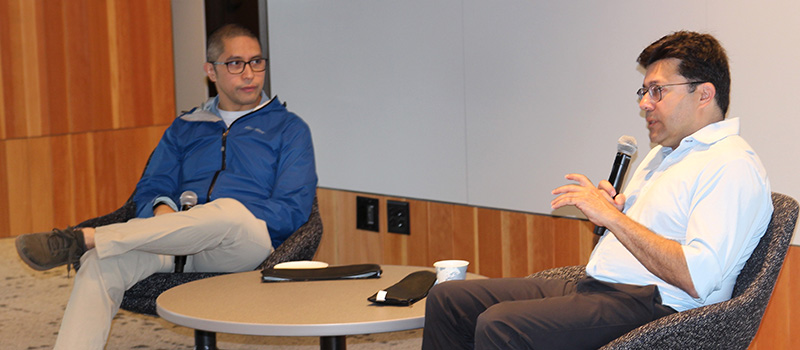 Ali Akgün ’93, right, and Associate Professor Peter-Michael Osera discuss AI during the Coffee with the College on April 17.
After retiring from Microsoft last year, Akgün now advises technology and education organizations, including start-ups and a venture capital firm. He’s a faculty advisor at Seattle University and also on an industry advisory board for the university’s electrical engineering and computer engineering departments.
“I don’t think I’m unique in that I think a lot of people when they get to a certain part of their career, they start thinking more about giving back rather than building more,” he says. “And I feel like I’m in that moment right now. I’ve been wanting to do something for the school that got me started, and perhaps my experience and perspective as someone in the tech industry can be helpful.”
While back in Iowa, Wang enjoyed meeting with her former tennis coach and retired athletics director Dee Fairchild, along with Betty Moffett, retired Grinnell College Writing Lab teacher, and Susan Ratcliff Drake ’58 and her daughter Melanie Drake ’92 and son-in-law Tom Wickersham ’90.
“After going back and spending the week there, I realized Grinnell really shaped who I was,” Wang says. “A classmate of my son got into Grinnell, and she called me to ask me what my experience was. And I talked to her for an hour and a half. At the end, she said ‘wow, I could really tell the impact that school had on you because you talk about it with so much enthusiasm and excitement.’ I studied history, then I went to grad school, then I worked in nonprofit, then I became a commodities trader, and then I got into marketing. And every career I got into, I did really well because I see things differently thanks to Grinnell.”
Akgün agrees. “Being a generalist right now with these tools is a very good place to be,” he says. “Grinnell excels at teaching writing and communication and is a place where curiosity is encouraged. Among the computer science people that I worked with over the years, I felt I had a bit of an advantage because I had this broad liberal arts education and an ability to communicate. And I think that is even more important and helpful these days with all these tools coming.”
—by Jeremy Shapiro