New website focuses on long history of Chinese alumni at Grinnell
July 23, 2026 — Within a year of Tsung Chin (T.S.) Chao’s arrival in Grinnell from mainland China in 1921, there were 13 Chinese students enrolled at the College. They formed an active group on campus, introducing townspeople and fellow Grinnellians to Chinese culture and history, while participating in clubs, sports, and other events.
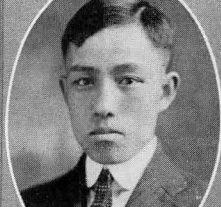 Tsung Chin Chao 1923
A 1923 Grinnell graduate, Chao sang in a program put on by the Chinese Students Club, celebrated the founding of the Republic of China in October 1922, and along with T.H. Cheng 1924, played flute at the local Congregational church at a Grinnell-in-China fundraising event. He later served as mayor of Jinta County, in the Gansu Province of China.
Though Chinese students in recent decades have been a highly visible and integral part of the Grinnell experience, their history stretches far beyond what many of today’s Grinnellians know. The early history of Chinese alumni is becoming more recognized thanks to the development of a fascinating new website, Early Chinese Alumni of Grinnell College.
Packed with historic photos, biographies, and facts on the lives of Chinese alumni from 1891-1947, the site was created by Orville and Mary Patterson Routt Professor of Literature Jin Feng, who teaches Chinese and Japanese at Grinnell.
Funded by an Andrew Mellon Foundation grant, Feng researched the experiences of Grinnell’s early Chinese alumni, then worked with several of her students and a student digital fellow, Chikako Inoue ’26, to develop the website.
“I thought it would be a good idea to share my findings across geographical and temporal borders,” she says. “It could serve as a platform for all kinds of exchanges, befitting a project that highlights cross-cultural exchanges from past to present.”
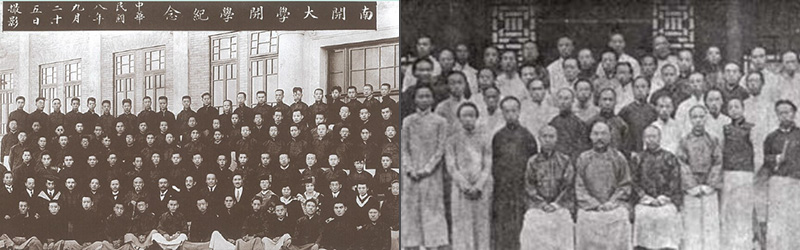 Early 20th century photos feature students of the Nankai and Tsing Hua Schools. Graduates from both institutions attended Grinnell between 1917 and 1924.
Although the first Chinese student arrived solo in 1892, most early Chinese students came to the College from three main feeders: Grinnell-in-China, which was established in 1916, the Nankai School, and Tsing Hua School.
The students were befriended by professors, including Professor of Applied Christianity Edward A. Steiner and Philosophy Professor John Dashiell Stoops, proponents of the Social Gospel Movement. In town they fostered relationships with clergy, their activities were reported on by the local papers, and they even taught residents how to play Mahjong.
“They were consciously trying to educate the public about China while attending Grinnell,” says Feng. “Our first Chinese graduate, Hsueh Cheng Hou 1916, taught a Chinese class on campus on the weekend.”
The 38 biographies detailed on the website give in-depth looks at the alums’ lives before, during, and after Grinnell.
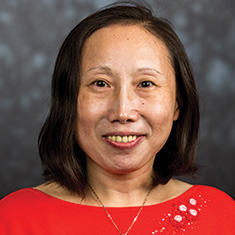 Professor Jin Feng
Five students from Feng’s Readings in Chinese Literature class last spring – Clara Chaput ’26, Grace Cuddihy ’26, Beatrice Durham ’27, Yiqing Wang ’27, and Cameron Welch-Groves ’26 – translated five of those life stories. The Mellon grant also funded two student research assistants in summer 2023: Steven Zhenlan Hu ’26 and Mahiro Noda ’26.
Chaput translated the biography for Tsu Lien Wang, who attended Grinnell for one year then transferred to the University of Chicago in 1918.
“I went into this project skeptical, wondering if I would be able to relate to these Grinnellians,” Chaput says. “But as soon as I started reading and translating, their humanity and likeness jumped off the page. I thought that was pretty cool.”
The biggest thing she learned was that “despite growing up in different eras and different countries, Wang and I are quite similar. Like me, Wang was once a high-achieving Grinnellian who found ways to flourish, even through life’s adversities. I learned that his path to ‘success’ was not linear and that he, too, spent much of his adult life exploring what interested him. From being a professor at Fudan University and National Central University, to heading the Overseas Bureau Section to managing Shanghai City’s banking industry and trade associations, Wang did it all.”
“I would like to believe that Wang’s time at Grinnell impacted his lifestyle, in that a quintessential part of being a Grinnellian is our ‘go forth’ mentality, one which allows us to explore what sparks our joy and curiosity,” Chaput adds.
Feng also credits the work of Emeritus Professor of History Daniel Kaiser, whose research on Ancestry.com “yielded interesting tidbits not available from traditional academic venues.” In one case, the site yielded important information about the only female Chinese student from that period, Ngai Chen Shih, who disappeared from Chinese records after 1936. She attended Grinnell from 1918-20 and then transferred to the University of Iowa.
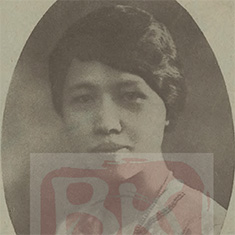 Ngai Chen Shih
“We were able to trace her through her U.S. arrival, naturalization, and marriage records, Feng says. “It turned out that she got married to another Chinese alum of Grinnell, Chung I Tseng 1920, in January 1937, and lived in the U.S. until she passed away in Michigan at 105!”
Most of Grinnell’s early Chinese alumni returned to China with Western knowledge in the sciences and social sciences, and quite a few became professors, as well as civil servants and diplomats. “They played important roles in Chinese modernization, even though their names were later erased or hidden from official histories of the two nations,” Feng says.
Grinnell College’s Vivero Digital Fellows Program played a crucial role in building the site. Humanities and Digital Scholarship Librarian/Associate Professor Elizabeth Rodrigues and Digital Liberal Arts Specialist Tierney Steelberg mentor student assistants that help faculty and staff with digital projects.
Feng is continuing work on the site, and she’s writing a book based on her research while expanding on the significance of Grinnell-specific experiences. “I look forward to continuing and deepening my exchanges with colleagues at U.S. and Chinese institutions,” she says.
—by Anne Stein ’84