Corporate pioneers
June 17, 2026 — As a senior partner at a major international law firm, it wasn’t unusual for Janet Carrig ’79 to enter a room full of clients and be mistaken for a secretary.
 Janet Carrig ’79
“That happened a lot,” says Carrig, a Yale-educated lawyer who served on Grinnell’s Board of Trustees from 1996 to 2001. “It wasn’t disrespectful; it was the worldview at the time. That started to change in the late 90s.”
During her career as an HR executive, Dianne Jones ’74 was told that she needed to find a husband and make him happy, because she was taking a job from a man. Armed with an MBA and a relentless desire to succeed, Jones became vice president of human resources for Xerox Manufacturing, overseeing hundreds of employees across the globe.
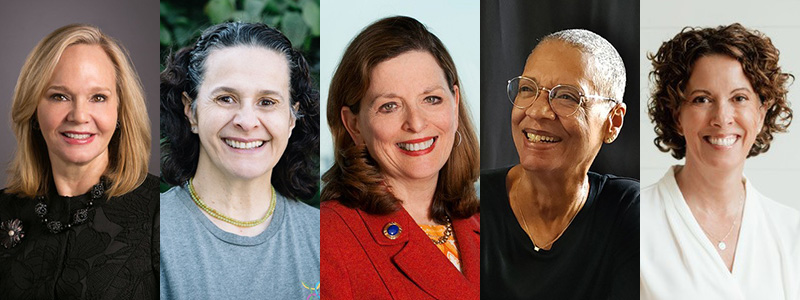
Throughout the 1970s and 1980s and even into the 1990s, women were a rarity in the upper echelons of corporate America. Yet a cadre of Grinnell alumnae became leaders in their fields at a time when maternity leave didn’t exist, sexual harassment was just starting to be discussed, and panty hose wasn’t optional.
From consulting and finance to law, HR and technology, these women were smart, tough, and determined. At the same time, they worked to foster progress and social change, leaving a legacy of greater opportunities for the women and men after them.
Breaking the glass ceiling
Eugenia Corrales ’87 was born and raised in Costa Rica. When she earned her physics degree at Grinnell and mechanical engineering master’s from Stanford University, she was often one of the few women in the classroom. She went on to leadership roles at tech giants including Hewlett-Packard and Cisco, has started and sold her own company, and is regularly called in to help Silicon Valley startups grow and flourish.
 Eugenia Corrales ’87
“At Cisco and HP, I was a rarity, but that was a different time, decades ago,” she says. “If you had two in 10 female engineers and promote from there, you’re going to have more men. But I was treated well. People took chances on me and gave me bigger roles that were traditionally done by men.”
As a startup CEO – she’s currently consulting with three companies – she’s still a rarity, although things are changing. “The STEM world is evolving. How many young women take advanced chemistry courses in high school, how many go to graduate school in STEM – all those numbers are getting better and that’s who becomes an entrepreneur. Women are coming from graduate programs at top schools with unique knowledge that allows them to start a company.”
When Asha Moran ’92 re-entered the consulting world after earning her MBA from Northwestern in the late 90s, she was one of six women out of 80 in the supply chain strategy practice at Anderson Consulting.
“Relentless preparation was one of my skills, and I took jobs others didn’t want to do,” she says. “I also had a good [male] mentor who advocated for me.” Still, “there was less assumed competence based on your gender.” It wasn’t unusual for Moran to be dismissed by clients until she started talking.
Sexual harassment training was just at the beginning. “Colleagues would talk about totally inappropriate topics,” she says. And celebrations at strip clubs “were a thing.”
“In my era of consulting I was single and ready to work hard,” she says. “When I got to the point where I had kids, my mom moved and took care of them so my husband and I could work. That was a huge gift that took that part of the traditionally female obligation off the table.”
 Asha Moran ’92
Today, she and her husband run a small technology company in Tennessee that they bought in 2020 – and she still bumps into gender issues. “Competence isn’t assumed in high tech when it comes to being female. I’ve had to say to a vendor, ‘do you understand that I own the company?’ But power trumps gender, and once they’ve figured out who’s in charge, there’s no problem.”
When Carrig became a partner in the early 1990s at one of the largest law firms in the nation, female partners were rare. Later, as general counsel at several Fortune 100 companies, she was one of the few women in the board room.
“I really enjoyed the legal issues, whether it was a transaction or large litigation or anything I had to really delve into. And I enjoyed building teams and developing younger people,” says Carrig, now retired and living in Houston.
Socially, however, there was a clubbiness that women weren’t a part of throughout her career. “The men played by different rules,” Carrig says. “They’d have a meeting before a meeting that in my experience was hard to get invited to, and they were more comfortable dropping by each other’s offices. After work, they’d go out for drinks because they had spouses who didn’t work, so they didn’t need to get home to take care of children and prepare dinner.”
In her era, women attorneys started asking for reduced hours during pregnancy and afterwards. “Women needed a little more flexibility, especially when they were younger,” Carrig says. “There were huge conversations at the time about the fairness of a lawyer working part time [during maternity leave] even if they were paid less.” Some lawyers joked about working part-time so they could work on their golf game.
“We weren’t the original trailblazers,” Carrig says. “There was a generation before me that showed women could do this work. But our generation said we wanted our biological differences taken into account.”
‘Twice as smart, twice as good’
Jones was the first Black woman MBA hired by Xerox manufacturing, and the first Black woman in a labor relations role at Xerox.
 Dianne Jones ’74
“When I started in 1980, the VP of benefits and compensation asked me what it was like to be Black in an all-white environment.” Throughout her 16-year career, Jones was periodically told she wasn’t the most qualified and was only being promoted because she was female and Black.
By the time Jones left in 1996, she had won Xerox’s top company award once and was told she would have gotten it a second time, except they felt a less-deserving white male should get it.
“I really lived the old adage that you have to be twice as smart, twice as good, to get half as much,” says Jones, now happily retired and living outside Detroit. “I actually had a lot of fun, especially with the union guys. Once they got to know me and understood I was a fair person, we got along famously. There were times and people that were very accepting and supportive. There were also times and people that made me shake my head.”
During her decades-long career as a director and senior manager in credit and lending at several large New York City-based banks, Carol Edkins ’73 wasn’t a rarity in her field, although she may have been one of the few managers with a Ph.D. in American literature.
It was during her doctoral studies at University of Texas, Austin, that she took a summer course called Careers in Business. “It was like a first semester MBA, and at the end of the program we were interviewed for jobs,” says Edkins. With literature positions at a premium, she accepted an offer at Chemical Bank and spent the next 25 years advancing.
 Carol Edkins ’73
“The leader on the first team I was part of thought women should not be in banking,” she says. It didn’t stop Edkins, who eventually sat across the table from Michael Bloomberg (who later was mayor of New York City) when he was starting his company and negotiated a loan for Michael Jackson to buy his song catalogue. “I met some brilliant and important people, and made lifelong friends, women and men.”
Like the other women, Edkins says she was tough. “You have to be able to say no as well as yes. You had to develop thick skin, especially when you’re lending money. Especially when it’s not your money.”
Now happily retired in New York City, she says she was treated well apart from one issue: compensation. “I wasn’t paid what my counterparts were being paid and that still goes on.”
In 2022, the year Edkins retired, “I got a bump up in salary because someone noticed I wasn’t making the same as colleagues. You have to speak up for yourself and sometimes that’s hard to do.”
Progress
When looking back at her early career, Carrig says she’s proud of what her generation did. “We insisted on being treated as women, which meant bringing some of the personal into the professional. The next generation went even further, and the result has been mandatory paternity leave at many law firms, and that has been good for everyone. Men have benefited as much as women from having this very important other part of their lives recognized at work.”
“(The legal profession) is by no means perfect,” she adds, “but it’s changed so much that it’s almost unrecognizable since when I started.”
As CEO of Plum Laboratories, Moran can put progressive policies into place. “I really enjoy creating a culture in an organization, when you have the authority to put in parental leave or same-sex insurance rights,” she says. “There’s a better work-life balance for men, too. They want to spend time with their kids.”
Despite the gains, not all leaders will take a chance on you. If that’s the case, it may be time to hit the eject button, notes Corrales, who deliberately chose to partner with two women founders.
“If you’re on a team you don’t want to be on because you won’t get promoted or treated fairly, I tell people, especially women, to own it,” she says. “If it’s a bad situation, move on. Do an online course or take a chance in another industry or go back to school. Make it happen for yourself.”
—by Anne Stein ’84