Reconstructionist rabbi facilitates collaborative community that’s welcome to all
June 15, 2026 — For Rachel Weiss ’98, Judaism has always been central to her identity.
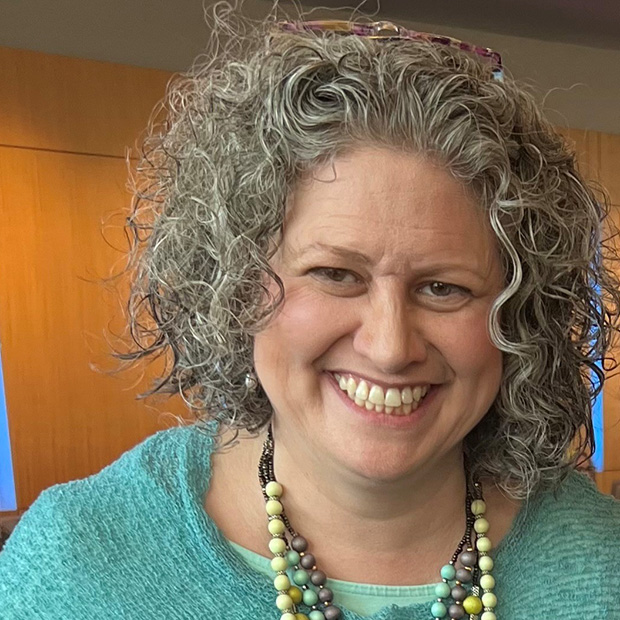 Rachel Weiss ’98
“My parents love telling the story of me asking to go to Hebrew school when I was 8 years old,” she says. Prior to this, her Jewish family had not been particularly religious, but soon after, they joined the Jewish Reconstructionist Congregation in Evanston, Illinois, where Weiss not only had her Bat Mitzvah, but years later was married and now serves as rabbi.
While she knew early on that she would become a rabbi, Weiss’ path to this moment was intentionally not a straight line.
As a Grinnell student, she explored many passions. “It was a time of self-discovery where I was trying new things,” Weiss recalls. “I learned how to integrate my academic and social interests.” She opted not to pursue religious studies as a major, because she knew she’d be fully immersed in that subject in graduate school. Instead, she majored in Spanish with a concentration in Gender and Women’s Studies.
While many people move further from their religion in college, Weiss deepened hers. She participated in the Shabbat Table in her first year, soon discovering that there was a need she could fulfill. “Danish Maid Bakery didn’t cut it for challah,” she says. “We were using one of the Forum PDR spaces to cook, so I suggested we bake our own.” Soon, Weiss was making challah every week, which is how she met her wife, Julia Tauber ’95.
“Julia was off campus my first semester,” Weiss says. “When she came back and resumed attending Shabbat Table, she wanted to know who was making the challah.” Soon, they spent every Friday afternoon baking together. “We connected and fell in love.”
As a senior, Weiss developed a bilingual education internship at Woodbury Elementary in Marshalltown helping ESL students who had recently immigrated.
“I love kids and was inspired by Ana Martínez-Alemán [former assistant professor of education and chair of the Gender and Women’s Studies concentration] who was the queen of intersecting social justice and education,” she explains. Weiss translated at parent conferences and helped teachers understand the needs of these students, hoping to better mediate tensions in a community that brought in immigrant factory labor while simultaneously calling authorities to conduct occasional raids. Grinnell recognized Weiss’ work with the Lori Ann Schwab ’95 Prize for Community Service in 1998.
After Grinnell, Weiss went back to the Chicago area as a social worker serving as the director of Nuestro Center, continuing work with recently immigrated Latino families. “I purposely didn’t go to graduate school right away because I knew that rabbinical work is all about being with people in their daily life, and I needed more of that real-world experience,” she explains.
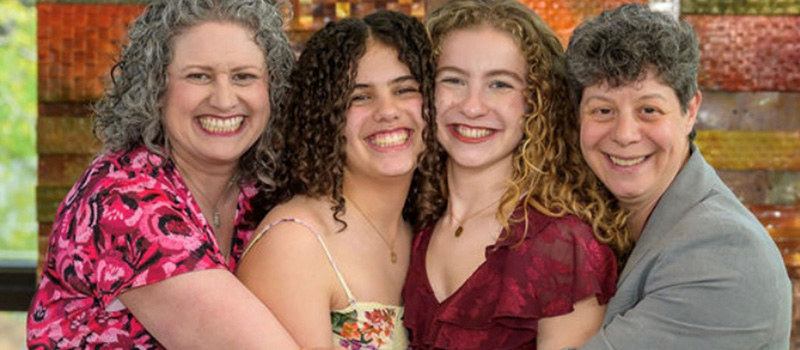 Weiss, Julia Tauber ’95, and their daughters Hannah ’30 (age 17) and Norah (age 12) take a family photo. Hannah will be a first-year student at Grinnell this fall.
She and Tauber, who had lived in Evanston since graduation, married in 2002, eventually having two daughters, the oldest of whom starts as a Grinnell student this fall.
While Judaism has not always embraced women or lesbians as rabbis, this never deterred Weiss from her path. Her upbringing in Reconstructionist Judaism was a key factor. “I had seen models and knew lesbian rabbis, so I was lucky in this way,” she says.
A relatively small movement, Reconstructive Judaism developed at the beginning of the 20th century as an approach whose core pillars are egalitarianism, democracy, participation, values-centered decision making, and innovation. While remaining deeply rooted in Jewish traditions, practitioners balance this with the needs of their ever-evolving congregants.
After graduating from the Reconstructionist Rabbinical College, Weiss began her career at Congregation Beit Simchat Torah, the LGBTQ synagogue in New York City, where she served as associate rabbi and developed a family education program. In 2014, her leadership was recognized by NY Pride Guide’s 45 under 45.
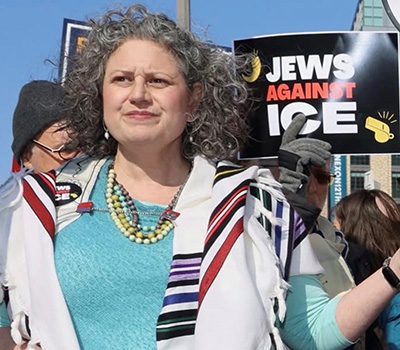 Weiss, a member of the Evanston Interfaith Clergy
and Leaders, is pictured at a protest.
When the opportunity arose to return to the Jewish Reconstructionist Congregation in 2016, Weiss was thrilled. “I love the idea of coming full circle, so it was a no-brainer,” she says. “Ten years later, I can confirm that the congregation and I are a good fit for one another.”
Participatory leadership is an element of Reconstructionist congregations, so the rabbi is not the only authority and is more often part of a collaborative process. This means that there are many voices at the table, and transparency in communication is crucial. “We do a lot of social justice work, and much of it is led by the congregants,” Weiss says. “We have different teams doing different things, so how the rabbinic voice fits is always a live one. My role is often from the back.”
The congregation has come up with many innovative experiences from a revitalization of their Jewish learning program that included moving it to Saturday morning to figuring out multiaccess programming during the pandemic – something they’ve kept since to continue providing more accessibility and inclusion. “We’ve also brought creativity around holiday observances,” Weiss says, highlighting the now traditional lakefront Shofar Walk to welcome the Jewish New Year.
“We are one of the very few synagogues that explicitly welcomes people who are Zionist, Antizionist, Nonzionist, are in flux, or are just beginning to learn,” says Weiss. “Everyone is welcome, and we have worked really hard to keep our wide tent open. My role is to facilitate how we come together as a congregation to talk about Israel and Palestine in a nuanced way that says, ‘I don’t agree with you, but I will still show up for you when your father dies.’”
In the last two years, the congregation has grown by 100 new households, a testament to their collaborative efforts. “We want to be sustainable as a congregation, so the partnership needs to feel strong and creative,” Weiss says.
Weiss is a member of the Evanston Interfaith Clergy and Leaders, a progressive group representing a wide array of faiths who coalesced after the 2016 presidential election. “We are a collective community, so it’s not about what can I do but what can we do,” she explains. “We stand together in Fountain Square whenever there is violence in the community or public attacks on different faiths.” Through this coalition, the mostly-white congregations have raised over $1 million to fund reparations for those in Evanston’s Black community harmed by systemic, historic racism, becoming the first municipality in the country to do so.
“I was always going to do something in the helping professions,” says Weiss. “This work encompasses all that I love: connecting, writing, teaching, and coalition building.”
—by Melanie Drake ’92
For your information:
Shabbat Table is still going strong at Grinnell on Fridays during the academic year. Join Chaverim and Rabbi Sarah Brammer-Shlay for the weekly event in JRC 209 when school is in session.
To read more alumni news, check out our news archive and like the Alumni & Friends Facebook page.