The education of a poet
January 22, 2026 — A short time before the poet Edward Hirsch ’72 spoke at the University of Georgia’s Poetry Festival in November, a small group of Grinnellians now residing in Athens, Georgia, wanted to say hello.
The group included Hirsch’s former English professor James Kissane ’52, along with his wife, Nancy Duke Kissane ’52, their son John Kissane ’82 as well as John’s son and daughter-in-law, William and Elizabeth Kissane.
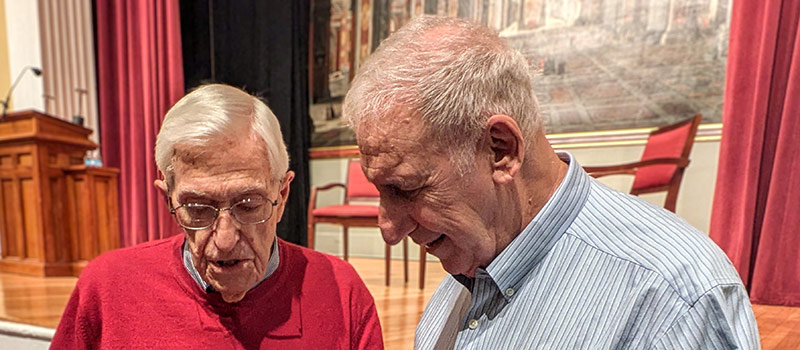 Professor emeritus James Kissane ’52, left, and Edward Hirsch ’72 catch up after a poetry reading Hirsch gave at the University of Georgia. Photos by John Kissane.
This was not the first time that Kissane, a fixture of the Grinnell English department for decades who is now an emeritus professor, and Hirsch, John Simon Guggenheim Foundation president, have reunited. (Once, while in Hirsch’s hometown of Chicago, Jim and Nancy spotted a poster for a Hirsch reading in a bookshop window and turned to see Hirsch walking toward them.) “Such run-ins have always added to the material admiration we’ve enjoyed over the years,” Kissane said. Nevertheless, given how fleeting life can be, every reunion has valedictory potential.
Reuniting was a wonderful experience, Hirsch, a MacArthur Fellow, advocate for the arts and artists, and an evangelist for poetry, observed that even at age 95, Professor Kissane’s wit remains as dry as ever. “I told him that back when I was a student, his jokes went so far over my head that sometimes it took me a year to realize he had made one.”
They also spoke about their shared recollections of the English faculty, who played a key role in Hirsch’s growth as a poet and writer, including Carol Miller Parssinen ’63, Sheldon Zittner, and Ed Moore. “We went through each person and talked about them, one by one. I talked about what they meant to me, and he talked about his friendship with them,” Hirsch says.
During his second semester at Grinnell, Hirsch took a humanities course with Parssinen. “Carol was the first person I knew who spoke in full sentences. She sounded like Henry James,” Hirsch recalls. He brought some of his poems to Parssinen, who both encouraged and challenged him.
“You can be a poet. You have the talent, the imagination, and the emotion to be a poet, but what you’re writing is not poetry,” Hirsch recalls Parssinen saying. “The reason it’s not poetry is that you’re not making anything, you’re just writing down your feelings. If you want to write poetry, you need to join yourself to poetry. Poetry is a made thing.”
Parssinen put him on a reading list which introduced him to poets John Donne and Andrew Marvel. “I was not writing good poems when I began to imitate them, but for the first time I was trying to become a poet,” Hirsch recalls.
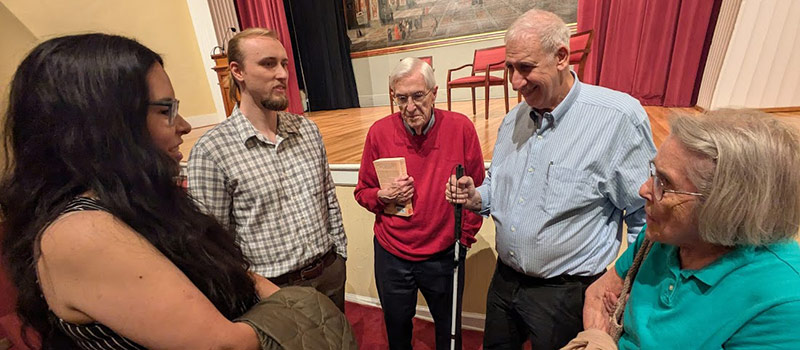 Hirsch enjoyed conversing with the Kissane family (Elizabeth, left, William, James, and Nancy) and reminiscing about classes he took at Grinnell.
Later, Hirsch took a course with Professor Kissane on Victorian literature and would discuss the English Romantic poets with him. “I learned the wit, cleverness, and the metaphysical way of making from English Renaissance poetry, and I learned about the depth of feeling from the Romantic poets, which were channeled to me through professors Kissane, Parssinen, Moore, and Zittner,” Hirsch says. “What I appreciated most about the faculty members I met at Grinnell who mentored me, tutored me, and became my friends was the depth of their character, their depth of feeling, their love of literature, and their love of transmitting literature to young people.”
In keeping with a liberal arts tradition, Kissane’s research and writing interests stretch far and wide including English Romantic poet John Keates, Sherlock Holmes, Charlie Chaplin, and British World War One author Donald Hankey.
“I’m really kind of amateur in the best sense of the word,” Kissane says. “The root – amo – in Latin means I love. I love to write and the subjects that writing takes me into. It’s a most delicious agony.”
The College has published a collection compiling decades of his writing, Mild Outbursts: Occasional Writings 1956-1995, and a poetry anthology he edited called Good Company: Poets from Grinnell College. (The title is a reference to an essay by Amy Clampitt ’41).
“I never particularly thought of Grinnell as a writers school, but a lot of writers have come out of there,” Kissane says. “It sparks our curiosity about what sort of poets come out of Grinnell.” Organizing the collection and introducing each of the poets “gave me the chance to get to know not only poets I knew as students or faculty members, but writers from quite a way back,” he says. The poets span more than a century from George Witchell 1882 to Kendra Ford ’93. Hirsch appears in the anthology as well.
Kissane considers his two stints teaching Grinnell-in-London, which combines the close-knit environment of Grinnell’s campus with metropolitan London, to be among his most satisfying experiences as a teacher. Another highlight was a version of the Grinnell Writers Symposium in 1986, which brought four alumni writers to campus all at the same time: Hirsch, Clampitt, Curtis Harnack ’49, and Rebecca Hill ’66.
Seeing former students continue to thrive brings him the most satisfaction. As John Kissane observes, “My father enjoys and truly values staying in touch with former Grinnell students. That’s been a priority of his over the years, and not just with those who go on to exceptional careers.” John says, “It’s clear my dad has always been a teacher first. That pretty well explains why he was at Grinnell College for half a century.”
Toward the end of their conversation in Athens, Professor Kissane said something to Hirsch that still is on his mind. It wasn’t a joke to be decoded months later, but a deeply moving sentiment:
“Grinnell was a wonderful place to spend a life.”
—by Joe Engleman ’14