Maritime attorney David Reisman ’89 oversees record Key Bridge settlement
August 25, 2026 — The largest single maritime property damage claim and settlement in U.S. history was orchestrated by a Grinnell graduate who as a student nearly decided the legal profession wasn’t in his future.
On March 26, 2024, a cargo ship named the Dali ran into a support column of the Frances Scott Key Bridge in Baltimore, causing the bridge to collapse. Six construction workers died and port operations closed.
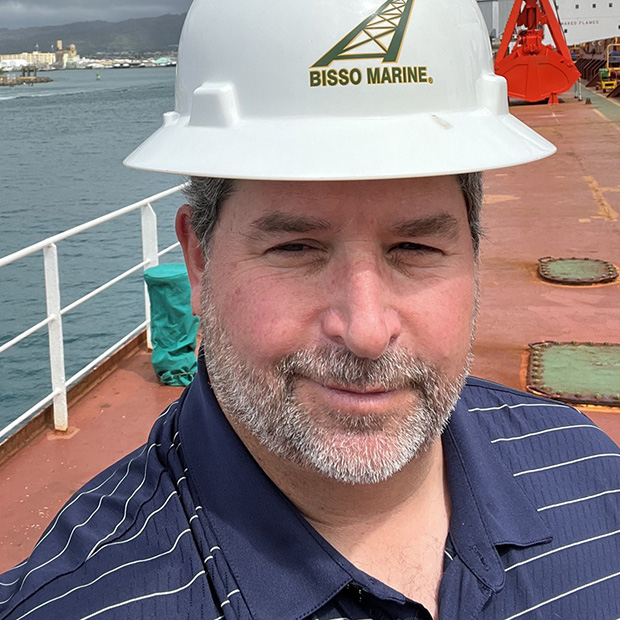 David Reisman ’89
Two years almost to the day after that tragedy, Grace Ocean Private Limited and Synergy Marine Pte Ltd., the owners and operators of the Dali, settled with the State of Maryland for $2.25 billion. David Reisman ’89, shareholder at the Liskow law firm in New Orleans, was the lead counsel for the State of Maryland. The settlement arises from a claim brought by the State of Maryland in September 2024.
“In the Dali case, I felt tremendous pressure because of our representation of all of the citizens of Maryland,” Reisman explains. “I had a responsibility to deliver for every one of those people.” He talked to Uber drivers, hotel clerks, and restaurant servers, among others, learning their stories about the bridge collapse and its personal effect on them.
“It cemented the feeling that so many people had been hurt by this, and I wanted to make it right,” Reisman says. “Over the years, I’ve had a lot of lawyers tell me not to take things too personally, which always makes me laugh. If you heed that advice, you may last, but you won’t be as good at what you do.”
The son of a lawyer, Reisman remembers always being interested in the legal profession. “It was all I knew,” he recalls. “But at Grinnell, I came close to going down another career path.” An avid sports fan, he learned that Norm Sonju ’60, then general manager of the Dallas Mavericks, was a Grinnell alum.
“I reached out not expecting him to reply, but the Grinnell connection worked in my favor,” Reisman says. “He told me that a career in sports such as his meant starting at the bottom with a slim chance of making it.” Consequently, Reisman heeded his father’s advice to attend law school to have something to fall back on, and once he started, he knew it was the right choice.
Raised in Florida, Reisman has always loved boats and the water, yet his career started in commercial litigation. “Most people in maritime practice have a real background in ships, such as attending a nautical school or working in the industry,” he says. After a year at Liskow & Lewis in New Orleans, Reisman realized that all his friends, including his wife, were in the maritime sector. Their work fascinated him.
“I was a bit of an anomaly, but they lured me in,” he explains. “When you introduce water to the dynamic, there are so many new variables, facts, and circumstances.”
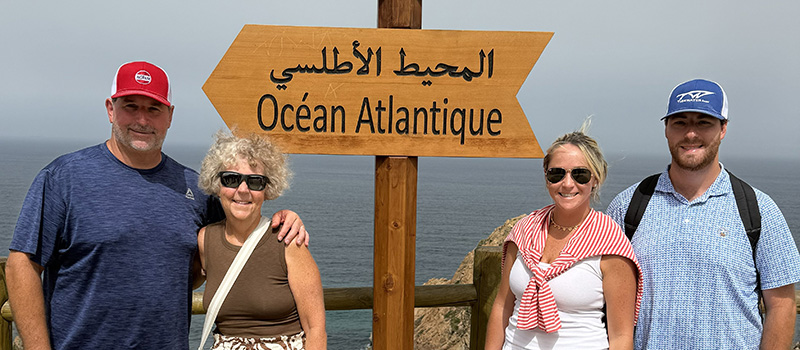 David, left, his wife, LuLu, and their children, Frances and Charlie, are pictured during a family trip in Morocco.
Reisman was soon ensconced in this work, finding that it came naturally, in part due to experiences he had growing up in Miami but also at Grinnell.
“I attended a large public high school with a wide range of people,” he explains. “Jeff Bezos was in my sister’s class, but we also had students who relied on the free lunch program. I learned how to communicate with people I sometimes had nothing in common with. Now, I’m just as comfortable in a board room talking with executives as I am out in the field aboard a ship.”
At Grinnell, he was exposed to points of view that challenged his own beliefs. “If you are going to be a lawyer, you have to learn how to think critically, defend positions, and be able to write,” he says. “Grinnell taught me all of these skills and is the reason both of our kids also attended liberal arts colleges.”
After 15 years as maritime section partner at Liskow & Lewis, Reisman spent a decade as general counsel for Bisso Marine, LLC, a global leader in marine salvage and wreck removal. This work took him around the world in a way he’d never imagined. “Often, we’d get a phone call, and I’d be on a plane that night,” he says.
In 2017 the company was sold, and Reisman returned to Liskow, this time armed with another unique set of skills.
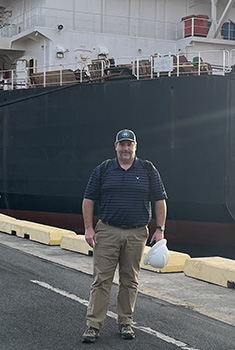
“When I went in-house [with Bisso Marine], it was transformative,” he says. “It exposed me to the business side that litigators generally do not connect with.”
In bigger cases, Reisman’s knowledge of how a large maritime company operates is game-changing because he understands how decisions get made, something that is hard to do if you’ve only worked in a law firm.
“When I was interviewed for the Dali case, it was what I refer to as a Slum Dog Millionaire moment,” he says, referring to the plot from the 2008 movie. “Everything they asked was what I’d had personal experience with, so it fit in my wheelhouse. What they needed was the culmination of what I’d been doing for the past three decades, so I was in the right place at the right time.”
Before the Dali case, Reisman represented vessel owners and marine insurers clubs in several large marine casualty cases including as lead counsel for the owners of the Golden Ray, a car carrier that capsized in 2019 when departing the Port of Brunswick, Georgia. In that incident, considered the biggest shipwreck in American history, all crew members on board were rescued although the cargo of more than 4,000 cars was not. Among other work on the case, Reisman defended claims against the owners and operators of the Golden Ray in federal court in Georgia and drafted and negotiated contracts for the largest marine salvage and wreck removal operations in this nation’s history.
Much of Reisman’s litigation work has been as a defender, so the Dali case was different. “I have to admit, I liked being on the plaintiff’s side this time,” he says. And while he is celebrated for this record-setting settlement, the memories he holds close are those conversations he had with countless Maryland residents, hearing firsthand their stories from that catastrophic bridge collapse.
“Over the years, I’ve had a lot of lawyers tell me not to take things too personally,” he says. “But for me, that’s exactly what makes me good at what I do.”
—by Melanie Drake ’92