“This is why we come here”
April 22, 2026 — As any student in, or alum of, a creative writing course at Grinnell can attest, there comes a point where a professor will say something to the effect of ‘pursuing writing professionally is something a student should only consider if they can’t do anything else.’
Sam Tanenhaus ’77 added a corollary to that during his 2026 Scholars’ Convocation talk on April 2:
“A friend of mine told me ‘journalists are people who fail at something else.’ In my case, I failed at everything else.”
Failing at everything else has brought Tanenhaus a great deal of success. He’s worked as a staff writer at Vanity Fair and a journalist at The New York Times including serving as the editor of The New York Times Book Review and its Week in Review section. His freelance writing and literary criticism have been published in the Times’ Book Review, The New Yorker, and The New York Review of Books.
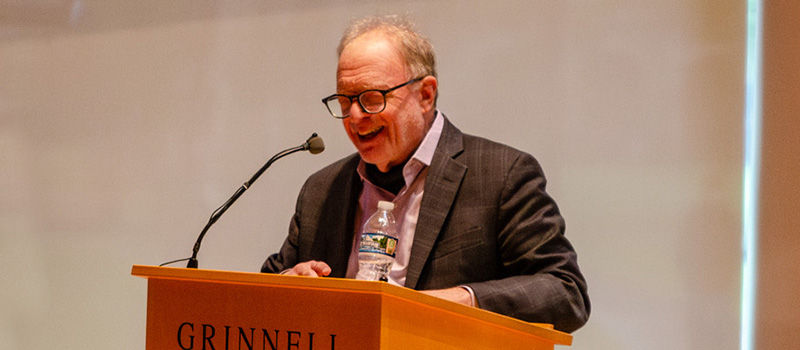 While back at his alma mater, journalist and historian Sam Tanenhaus ’77 gave a 2026 Scholars’ Convocation talk on April 2.
He’s published a brief biography on Louis Armstrong, a concise and comprehensive introduction to literature called Literature Unbound, and expanded essays first published in The New Republic into 2009’s The Death of Conservatism: The Movement and Its Consequences, which traces conservatism from the 1950s to the earliest days of Barack Obama’s presidency.
Tanenhaus may be best known for two biographies, both novelistic in scope, of mid-20th century writers and political figures: reporter and critic Whittaker Chambers (which was a finalist for the Pulitzer Prize and the National Book Award and netted Tanenhaus the LA Times Book Prize) and now National Review founder and Firing Line host William F. Buckley.
In Buckley: The Life and Revolution That Changed America, Tanenhaus explores a person of deep contradictions: Buckley was an eminently generous person, singularly devoted to advancing radical conservative beliefs, and someone who intersected with a who’s who of American political, literary, and cultural figures from Joe McCarthy and Watergate organizer E. Howard Hunt to Joan Didion and Susan Sontag, plus countless more in between.
During his time on campus (his first trip back since the graduation of his daughter, Lydia Tanenhaus ’14), Tanenhaus was hosted by the Rosenfield Program in Public Affairs, International Relations, and Human Rights, sat in on a pair of creative nonfiction courses, and met with and praised the professionalism of the student journalists at the Scarlet and Black. He also reconnected with Professor Stephen Andrews who sat in on Tanenhaus’s short course on magazine writing back in 2012 and attended lunch with students in Professor Erik Simpson’s seminar on James Joyce’s Ulysses.
The latter two experiences made it into his convocation address because of the ways that both journalism and Ulysses intersected with Buckley’s life. Tanenhaus identified Buckley as one of the most “accomplished student journalists of the 20th century” and weaved in an anecdote, cut from the book, where he asked Buckley about all the time he spent doing extracurricular activities in college. Buckley replied, “Well, I suppose I could have spent my time reading Ulysses.”
Tanenhaus and his partner, Kathy Bonomi, have been reading Ulysses recently, so he asked the students in Simpson’s class what they thought of the book’s most famous line (“the heaventree of stars hung with humid nightblue fruit.”) and shared that Joyce said it took him eight hours to compose that single sentence.
“I’m surprised it didn’t take him longer,” one student remarked.
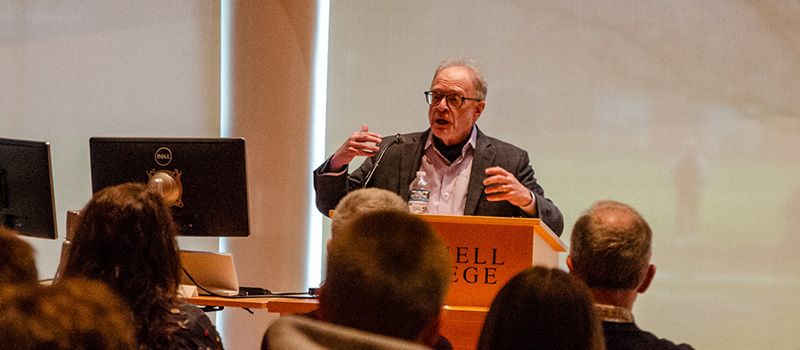 A large turnout of students, faculty, and staff listened to Tanenhaus talk about William F. Buckley, the subject of his latest biography.
That analysis, Tanenhaus said, was indicative of why people come to Grinnell for a liberal arts education. It’s learning to write and communicate, taking time to think things through carefully, and possessing a curiosity about the world.
A major part of transmitting those ideas at the heart of a liberal arts education are Grinnell faculty members who remain “the most distinguished and cultured people I have ever met in my life,” Tanenhaus says. While too many to all name, Tanenhaus mentioned Professor Michael Cavanagh who taught John Milton, Tanenhaus’ advisor professor Peter Connolly, and James Kissane ’52.
Connolly convinced Kissane to let Tanenhaus into his seminar on the poet John Keats, which introduced Tanenhaus to the comprehensive literary biography (and was the only time he encountered one in academia). “The life of the author turned out to be the most interesting thing to me,” he says, “which is a lesson: you never know what you’re going to end up doing professionally and what will feel right for you.”
When the reader reaches the end of Buckley’s life and turns to the acknowledgements section, they get a sense of all the ways that the College, its faculty, and its alumni have supported the book in significant ways. Lydia transcribed interviews, brother David ’90, now a history and law professor at the University of Nevada at Las Vegas, offered pointers in legal history, Ken Braun ’77 provided background on Congolese politics, Brian K. Ladd ’77 translated a German language biography of National Review co-founder Willi Schlamm for him, and Polly Morrice ’77 helped him untangle the politics and religion of the American South.
As Tanenhaus closed his lecture, he wanted to take something away from Buckley’s life: that often he didn’t play it safe. Tanenhaus pointed to Buckley’s first book, God and Man at Yale, which closed with a vehement chapter that friends and mentors encouraged him not to publish because it would cause a stir. But Buckley, at the age of 25, wanted the stir, included the chapter, and landed the book on The New York Times bestseller list, ushering in “the beginning of the conservative political revolution in America,” Tanenhaus said.
“I mention this to students not because I think you should agree with Buckley; I don’t think many of us would,” he continued, “but he was not afraid to make the case he wanted to make. Sometimes I think that’s subsiding now and people may not have the courage to do it in this tough time.”
Taking a stand for something need not entail a revolution or making the bestsellers list at a young age, but it may offer its own kind of patience, satisfaction, and success. And if at first you don’t succeed, there’s always journalism.
—by Joe Engleman ’14